make something
marx, alianation and art

what is alienation
In Karl Marx’s writing on estranged labour, he introduces the concept of alienation. Alienation describes a sense of exclusion and separation from the product of a worker’s labour.
“… the object that labour produces, its product, stands opposed to it as something alien, as a power independent of the producer.”
- Economic and Philosophical Manuscripts of 1844. Karl Marx, Estranged Labour
Essentially, what this means is that when workers get separated from the products of their labour, there is a lack of connection between the worker and said products. For example, if I were to buy a desk off Amazon I would not see it as anything other than a commodity. Whereas, had the desk been designed and built myself, there would be a deeper connection formed between me, the worker, and the product.
On the other hand, if I worked in an assembly line producing desks but never got to interact with the final product, I, the worker, am once again estranged from the product
Forms of alienation
Alienation from the product. As a worker, one becomes alienated from the product in the sense that they do not get to have the product. Whether you are a factory worker or a designer, for example, you play a part in the process of making a product without ever getting to have and enjoy the finished product. Because the product isn’t yours. It is for others, even though it is your hard work that plays a part in its creation. Oftentimes, workers cannot even afford the products they help create themselves, and so they are further alienated from it.
From the activity of creating the product. The way in which work is organised divides the different parts of the production process. One person designs your clothes, another sources the material, another puts it together, and so on. Thus, workers only really play a part in a small facet of the creation of the product. This furthers the gap between the worker and the product as the product isn’t ever even truly their work.
From our species being. The organisation of work further creates a culture in which people are their professions. Their identities are inextricably tied to what they do for work. You are not simply a person with your own traits. You introduce yourself and immediately disclose your profession because it is one of the most important parts of who you are. You never really get to be who you are because who you are is a worker.
From each other. The workplace often requires much interaction between people but this interaction is between workers—not humans. Instead of making friends, we network. Instead of forming bonds, we make connections. And so, at times, we begin to see others as tools or conduits through which we can get more work done or get work done more successfully. At what point do we stop forming relationships with people because they are a good person to know but rather because they are a good person to know.
creations that are ours to have
What I want to focus on is the relationship between a person and the product of their labour. When everything is centred around work, nothing is truly ours and we never genuinely get to connect with anything. Even in the digital age, it’s all about content, but content is a product for others, not ourselves.
Which is why we need art. Because real art is what can truly be ours. I don’t mean art as in paintings, no, I mean art as in what is ours and is for us. Regardless of the medium, anything can be art—whether it be created through words, watercolour, or anything else—because art is about passion. When we create art, we are active participants in its becoming. In this way, we are inseparably bonded to our art.
Art is most important for the creator
I write this blog for myself and so that I can share my craft with others. Because I love to write. It is part of who I am. There is no world in which I am fulfilled and I am not writing.
When we create art, that art is a reflection of who we are. It contains a part of us because it is a culmination of our thoughts and experiences. Even now, as I write this essay, I am revealing and uncovering facets of my being and embedding them in my work. What I create can even, at times, tell you more about me than it does about the subject of the art. This is a sentiment expressed by Oscar Wilde in ‘The Picture of Dorian Gray’
“Every portrait that is painted with feeling is a portrait of the artist, not of the sitter.”
- Oscar Wilde, The Picture of Dorian Gray
What this means is that if I were to write about a thinkpiece on a celebrity, my writing would reveal my worldview, my beliefs, and my nature more than it would reveal anything about the subject of the piece. And so, when we create, we concretise and immortalise a facet of our being.
When Basil, the artist, speaks to Dorian Gray of his portrait, he says:
“I know you will laugh at me,” he replied, “but I really can't exhibit it. I have put too much of myself into it.”
- Oscar Wilde, The Picture of Dorian Gray
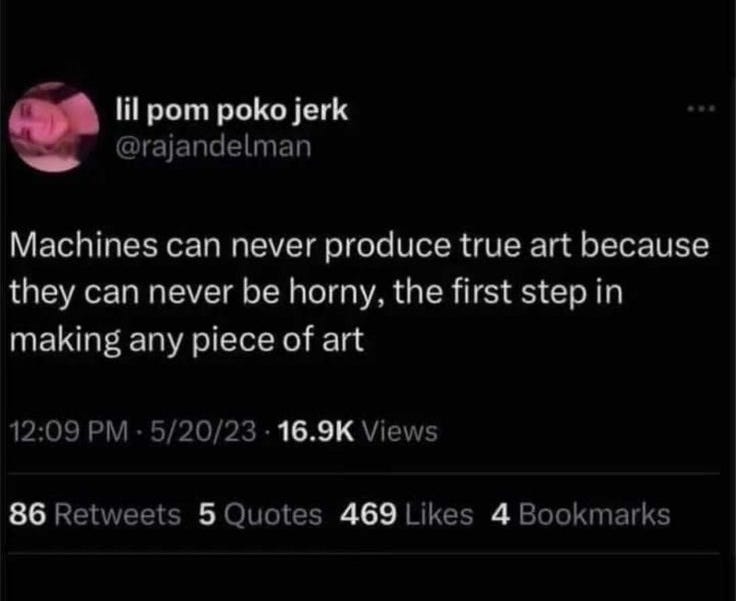
When we create art, we share a piece of ourselves and bare our soul for others to see. This is a true act of vulnerability. But what is more important than the vulnerability of it is the sense of connection we have to our art. This is where we find true fulfilment. In creating and thus connecting with our inner selves. This is what no other person, machine, or no artificial intelligence can replicate. The satisfaction of having something that is truly ours. This is why it is important to have a creative outlet regardless of whether what you create is ‘good’.